Superman

The Man of Steel

Batman

The Dark Knight

The Avengers

The Earth Mightiest Hero

Justice Leaque of America

The World Greatest Hero

Captain America

The Rael American Hero

Spiderman

Your Friendly Neighberhoud.............

Ironman

Not Just A Man In Iron Armor

Green Lantern

"In The Brightnest Day......and Blackest Night............."

X-Men

For The Gifted

Daredevil

The Man Without Fear

Fantastic Four

Mr Fantastic, Invincible Woman, Human Torch, and The Thing

Ghost Rider

Born From Hell............Sworn To Justice

Thor

The God Of Thunder

Wolverine

The Beast

The Hulk

The Monster Inside The Jenius

Showing posts with label Batman. Show all posts

Thursday, January 12, 2012

Review: Batman: The Black Mirror hardcover/paperback (DC Comics)

With issue #881, DC Comics's own stalwart "gray lady," Detective Comics, closes its doors after almost seventy-five years. By all accounts, writer Scott Snyder ends Detective on a high note with Batman: The Black Mirror (in contrast to the end of its sister title in Batman: Eye of the Beholder). Black Mirror is a stout, involved collection worthy of its praise.

Perhaps the great point of debate, then, is where exactly Synder excels in Black Mirror. Is it in convincingly depicting Gotham City as a character with its own presence? In creating a story that succeeds in taking Batman and his allies back to their earliest days despite that this Batman is Dick Grayson and not Bruce Wayne? Or is it in presenting a slow-building horror story populated with the kind of twenty-first century villains that act as a signpost for where the Batman titles need to go in DC's New 52 continuity? All of this is the case, to be sure, and more.

[Contains spoilers from this point forward]

Perhaps the greatest delight for me in reading Black Mirror was to discover -- and I was rather surprised to find this hadn't been spoiled for me some time before -- that Snyder out-and-out suggests that Commissioner Gordon knows Batman's identity (at least Batman Dick Grayson's identity) in this story. Wherever one stands in the "Gordon knowing" debate, it's quite appropriate that Synder should "go there" here in the final pages of Detective Comics.

I'm of two minds whether Bruce Wayne deserved a cameo in these pages or not. Gordon's pointed "thank you" to Dick at the end of this book is a strong moment (on par with Barry Allen's "You're welcome, Bruce" at the end of Flashpoint [yeah, I'm still digging it]), something a long time coming and right for Detective's closing pages, though it would seem better spoken to Bruce. Black Mirror is Dick Grayson and Commissioner Gordon's story, however, and Bruce's presence might have overshadowed that; Black Mirror is in part about Gordon coming to see Dick as a man and not a boy, and Bruce's absence (resurrected, though overseas) reinforces Dick's new role, that he and Gordon are "on their own."

In considering the Dick/Gordon relationship, Snyder creates whole cloth here a portion of the Batman mythos effectively erased by 1986's Crisis on Infinite Earths and only shown in bits and pieces since -- that is, Dick Grayson's tenure as Robin. We have seen (a couple times) new takes on the death of Dick's parents and his debut as Robin, but what about the rest? Didn't Dick Grayson go to high school? Have friends?

Snyder illuminates a kind of "Gotham High" period, where Dick went to school with Barbara Gordon and thought her brother James, Jr., was kind of weird (we can imagine Dick's Smallville-esque freak-of-the-week adventures). On just the sixth page, after Synder puts the words in the characters' mouths, it seemed so obvious as if it had been there all along -- of course Dick and Barbara went to prom together, and of course a disapproving Commissioner Gordon drove them. And so unfolds a complete history of the Waynes and the Gordons, a kind of Gotham City Capulets and Montagues, bringing to light that missing time between Batman: Year One and when Dick Grayson left the Batcave.

Inasmuch as Black Mirror is rooted in Frank Miller's Year One -- fittingly, bringing the modern Batman era full circle -- Synder seems to take pains not to make Year One required reading here. Though Snyder, with artists Jock and Francesco Francavilla, revisits more than once the bridge where readers last saw baby James, Jr., be knocked over the side and caught by Batman Bruce Wayne, Snyder resists the urge to actually reference the scene, leaving the story accessible to new and experienced readers alike.

In keeping with Snyder's theme of Gotham as a corrupting influence, that Black Mirror comes full circle from Year One is not necessarily a positive. Batman's first victory, saving James, is in fact a tragedy given the monster that James has become. Batman could have no sooner let James die, but the reader intuits that the fall off the bridge, or even some way that Batman caught James, might have caused James's psychopathy. Over the course of the story, Synder implicates all of the characters in the way that James turned out, but Bruce was there at the beginning, perhaps the trigger of it all.

I had heard talk of Snyder using Gotham as a "character" in this book and I was skeptical; I don't cotton much to the idea of Gotham as a supernatural "being," and we've seen a "walls have hypnotic suggestions" kind of plot recently in Batman RIP. Synder offers suggestion after suggestion, however, of the potential evil inherit in Gotham -- from the decades-old secret society devoted to evil artifacts, to how Gotham is built such that the corners of the city are hidden from the sky, to the implication that all the baby food in Gotham might be poisoned, and how Snyder references tragedy after tragedy: the deaths of Dick Grayson's parents, Robin Jason Todd, Gordon's wife Sarah Essen, and Barbara Gordon's crippling by the Joker, among others.

Black Mirror is a horror story, to be sure -- possibly the scariest Batman story I've read, and one whose horror wouldn't have worked if it was the experienced Bruce Wayne in the cowl and not Dick Grayson -- and in example after example, Snyder wears down the reader. I believed in James's theory of the destructive "Gotham moment" by the end; very possibly I "get" Gotham City in a way hundreds of Batman stories didn't make so vivid before now.


We've recently heard news of Snyder's forthcoming "Court of Owls" crossover in the DC New 52 Batman titles; I've not yet seen Snyder's new villains like the Talon, but I hope they're commensurate with those Snyder created here. Short of the Joker, none of Batman's established rogues appear here -- rather we have James (without even a villainous codename), the Dealer, Tiger Shark, and Roadrunner. If these villains are costumed, it's only barely; instead they're auctioneers, businessmen, modern pirates, a kind of outlandish and yet sedate foe that suggests to me a more modern Batman.

Superman is always going to fight giant robots, but for the New 52 to keep attracting new readers, I think this is the direction Snyder and others have to take Batman -- not necessarily fighting fanciful villains like the Riddler, but rather those easier to imagine as a threat just around the corner, like James, Jr.  Just as Synder is not leaving the DC Universe, Black Mirror is an end but also a beginning of things to come, if DC so chooses.  I hope they do.

At the same time, it's equally surprising to me that neither Jock nor Francavilla are drawing titles in the New 52; Francavilla's rounded edges perfectly evoke David Mazzucchelli's Year One pencils without copying outright, while Jock appears quite at home not only in the book's most gruesome moments but also as Batman swings above the city. I did have a little trouble with Jock's civilian Dick Grayson, who in his polo shirts more resembled Bruce Wayne (further, I thought Synder made a rare mischaracterization of Dick in employing him at a science lab; granted Dick was trained by the Dark Knight, but I don't often recall him depicted as a forensics expert), but these are small hiccups in an otherwise stellar volume.

I'm sure you know by now, but Batman: The Black Mirror is indeed, as you've heard just about everywhere, one of those rare collections you hope for, a satisfying, cohesive story from beginning to end. Collecting eleven issues (some oversized), Black Mirror is an example to me of a collection done almost right, something you buy that takes a while to read and that you can really sink your teeth into.  Snyder, to an extent, makes it seem effortless; for a long time to come, no doubt, we'll be saying that books are good, but they're no Black Mirror.

[Contains original covers, sketchbook section, promotional art, sample script. Printed on glossy paper.]

Done "almost" right, you say? Yes. Because as perfect as Black Mirror is, I still fervently wish DC had stripped out the issue credits that appear at random intervals, sometimes at the beginning of a story and sometimes at the end (so, sometimes one right after another). We know who wrote and drew the book -- it says so at the very beginning -- and these incessant credits, like never-ending station identifications, are the worst kind of interruption from outside the story. Black Mirror could read as a graphic novel -- it's so close -- if not for the issue credits. DC, if you're listening, think about it, please. For me?

Monday, January 9, 2012

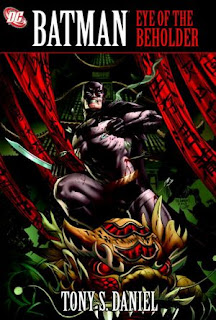
Review: Batman: Eye of the Beholder hardcover/paperback (DC Comics)

It's hard not to imbue Batman: Eye of the Beholder with some kind of greater meaning (for me, at least) given that it's the final originally-numbered Batman comics collection before the DC Comics New 52 relaunch. Not that writer Tony Daniel is necessarily writing it as such; it's unclear how aware Daniel was of the DC Relaunch when he wrote these issues, and DC omits from this collection the actual "final" Batman issue written by Fabian Nicieza.

Eye of the Beholder is adventuresome, though not necessarily Daniel's strongest work; as a Batman finale, there's a bit one can read into this book, but overall in that aspect the book doesn't really measure up.

[Contains spoiiers]

Depending on your point of view, Tony Daniel either has a great sense of Batman continuity, or his Batman stories are mired in re-treading old material. The "Eye of the Beholder" storyline picks up from the much-maligned Resurrection of Ra's al Ghul crossover, while "Pieces" is even more enmeshed in Jeph Loeb and Tim Sale's Batman: The Long Halloween and Dark Victory than Daniel's previous Batman: Life and Death was. This works for "Eye," creating something interesting from the preceding story's ashes, but "Pieces" revises Loeb's work in ways better left alone.

The four-part "Eye of the Beholder," Daniel tackles some of the Asian-influenced elements of the Batman mythos, using both the Sensei villain and the 1970s martial arts mystery man I-Ching. The story is of a kind that works especially well for the young Dick Grayson Batman: a mysterious woman approaches Dick both in his civilian Wayne Enterprises identity and as Batman, and Dick must help her retrieve a powerful artifact while balancing his mistrust for the femme fatale.

It's simple enough, though Daniel adds some elements of mystery and -- I noticed in Life After Death as well -- seems especially skilled at leaving hints in both the dialogue and the art that allow the reader to try to solve the puzzle alongside the Dark Knight. I also appreciated that Daniel's art seems to have continued to evolve between the last volume and here, gaining a more pencilled, sketchy look that I thought was unique and enjoyed.

"Pieces" didn't work as well for me. Gilda Dent, Two-Face's estranged wife as of Long Halloween returns, working against Two-Face in a relationship with gangster Mario Falcone; later it seems Dent is only fooling Falcone to protect Two-Face. It's all a bit of a stretch, including the unlikely partnership between Falcone and Dent given that Dent catalyzed the downfall of the Falcone family; the story plays on Halloween but doesn't seem entirely faithful to it.

Daniel's writing and dialogue are good, but when he enters Long Halloween territory, even having the characters quote lines from the earlier book, Daniel seems to stomp around where Loeb danced gracefully. Gilda Dent is no longer the mysterious killer in the shadows, but now a kind of whiny figure still inexplicably wearing gangster fashions. Guest-artist Steve Scott's work lacks the detail of Daniel's earlier work (and some judgement, as when Scott unnecessarily depicts one thug vomiting on another) and certainly the subtlety of Sale's noir original. Combined, this makes "Pieces" a clunky follow-up to the originals, and fans of Long Halloween and Dark Victory who would come here hoping for more about their favored characters would likely be disappointed.

"Eye" itself is cute, but doesn't hold a candle to Daniel's Life After Death. This is in part because, whereas some of Life After Death's draw was the unexpected presence of the Falcones, here Gilda's reveal is fairly obvious. Eye, as a whole, is not as snappy a mystery as Life; Eye's villain, the Sensei, is a kind of outlandish figure versus the spookier Black Mask before. I also liked that Life was a Gotham City story, dealing with Commssioner Gordon and the Wayne Foundation and Arkham Asylum, whereas Eye is more self-contained. In all, my hope is that Daniel returns to Life After Death's form when he takes over the new Detective Comics (and the reviews I've heard so far are positive). The "Eye" story didn't disappoint, but neither did it feel there was as much at stake for the characters.

Though I'm down on Daniel's use of Long Halloween and Dark Victory here, one could (if you tilt your head and squint) see it as bringing Dick Grayson's story full circle at the end of the Batman title. Dark Victory (depending on the day's continuity) was Dick's first outing as Robin; his final adventure in the Batman title ties in to that story. Daniel does not make as much of this as he could -- Two-Face and Dick Grayson specifically share a long history that Daniel completely ignores -- but there's at least a bit of symmetry to be imagined.

Further, I took note of Catgirl Kitrina Falcone's letter to Batman Dick Grayson at the end of this book. Kitrinia's never quite fulfilled a purpose in Daniel's two Batman books; rather I imagine Daniel ran out of time to delve into Kitrina (equally puzzling is the daughter Enigma that the Riddler introduces one issue, then kills the next). But there is a certain irony in Dick Grayson trying to dissuade Kitrina from a life of crimefighting -- it is advice that Dick himself never took. It seems as though, in the beginning of Kitrina's letter, that Dick has succeeded in dissuading Kitrina from following his own path -- Dick has unmade, in a sense, his own creation -- but in the end, Kitrina promises to return better than before.

Dick has not, as a matter of fact, succeeded at all; rather the heroism of Batman in his second iteration has now inspired a third generation, "Batman and Robin will never die" and all that. I don't actually think Tony Daniel meant Catgirl as a metaphor for the survival of these "old DC Universe" characters now heading off to limbo, but as they say, it's nice to think so.

[Includes original covers]

Batman: Eye of the Beholder, at least the first story, is enjoyable work by Tony Daniel, neither the worst Batman's ever been nor the best, though it is a particularly apt Dick Grayson story. Long Halloween purists may want to steer clear, however; I was excited when Daniel ventured into Loeb's territory in the last book, but some things may be very well better left alone.

Coming up next -- it's received rave reviews, and now you're going to get the Collected Editions take on Batman: The Black Mirror. See you then!

Monday, November 21, 2011

Review: Superman/Batman: Worship trade paperback (DC Comics)

I have been wary of these Superman/Batman books of late. With no ties intentionally to continuity and a mission just to "tell stories," the individual issues have tended to be hit or miss -- there's some gems among Mike Johnson and Michael Green's Superman/Batman: Night and Day, but Joe Kelly's Big Noise overall disappointed. Continuity is not the be-all and end-all, of course, but at times this title seems aimless.

Superman/Batman: Worship gave me special pause not only because it seemed to be one of these disconnected stories (this turns out not to be the case), but also because former DC Comics president Paul Levitz's writing has also been hit or miss for me. His first outing on the new (pre-DC Relaunch) Legion of Super-Heroes series, The Choice, was great stuff, but his Superboy and the Legion of Super-Heroes was not, and I recall calling his JSA: Ghost Stories "stodgy."

Worship, however, is a delight. With art by Jerry Ordway, the "Worship" story feels like its cut from the 1990s Superman "Triangle Titles" heyday, while at the same time adhering to the unspoken rules of the Superman/Batman title. Add a few contemporary twists at the end, and Worship emerges as something entirely satisfying -- a little bit classic, a little bit new.

[Contains spoilers]

In the main, the "Worship" storyline contains just four characters -- Superman, Batman, Lois Lane, and Lex Luthor. Levitz tells the story from their four perspectives, and Worship is at its best in the second and third chapters of that storyline, when Levitz parallels the thoughts not just of the heroes, as Jeph Loeb and others have done before him, but of all four characters. This little change gives the story unexpected depth -- we see not just how Superman and Batman try to solve their case, but also how Lois works alongside them, and how Lex moves to foil them. There are interesting ideas here that may not hold up to a lot of scrutiny. but serve as wonderful tidbits for consideration -- that Lex ramps up crime around Crime Alley in Gotham at times when he wants Batman distracted because studies show Lex that Batman has a focus on that area; and that even as Batman can't tell who's behind it, he's so attuned to crime in Gotham that he can tell there's a force working behind the crimes.

"Worship" is in part a re-telling of a series of Silver Age stories in which Lex Luthor becomes the "Superman" of a planet called Lexor, on which Superman is considered a villain. Levitz presents the concept of "worship" mostly in a negative context here; Superman considers early on that mankind creates their own (often erroneous) religious explanations for cosmic events. We see this both in the cult that worships Superman to the point of trying to kill Lois (egged on by Lex), and the aliens of Lexor who misunderstand Superman's intentions and worship Lex.

In an unusual storytelling choice, Levitz does not actually tie the two plot threads together, but rather ends the third issue with Batman and Superman's dual confrontations with Lex. The stories' connections are thematic rather than explicit and I appreciate Levitz letting the readers think for themselves. Further, the slightly unfinished nature of the entire tale again evokes the "Triangle Titles" era; we could just as soon imagine Lexor would show up again a few issues down the road (maybe Maxima would land there, or Draaga would try to take it over) as that Levitz would revisit it again in the final part of "Worship."

That last chapter is Superman/Batman #75, and rightfully so it's an anniversary-type time-travel tale that involves the future Legion of Super-Heroes and the past Superboy. For time travel in Superman/Batman, I might have liked to see some usage of "young Batman," too, but having Batman make a rare appearance beside the Legion is fun nonetheless. Only the hardest heart, too, could fail to be moved by Batman nursing a Kryptonite-infused Superman back to health in the Bat-cave while the Legion ventures into the past; great choice by Levitz to keep Batman on screen here, rather than replacing him with Alfred. A throw-away line or two, if you're into this kind of thing, keeps the timeline of the Superman/Batman story nebulous, but puts the Legion appearance just before Levitz's Legion: The Choice.

Long-time DC Comics artist Jerry Ordway is in top form in Worship. Throughout the "Worship" story (mainly in the first three chapters), it seems we have Ordway's colored pencils without inks, giving the sequences a painted quality; in the fourth chapter, Ordway's black lines are darker, and images like the close-up of Brainiac 5's face are rich with detail that show Ordway still at his best.

Ordway drew the original comics adaption of Tim Burton's 1989 Batman movie, and his depiction of the cowl still looks like Michael Keaton's; the artist follows this with a cape attachment, however, that looks more like Adam West's. It's no matter; if Ordway's imagining of Superman and Batman is a little dated, then it's dated in a way that depicts the characters from some of their best stories, like Ordway's "Dark Knight Over Metropolis.". Though almost twenty years old, those "Triangle Title" stories still hold up, and I'd be happy to see Ordway join his old teammate Dan Jurgens as part of the DC New 52 Superman relaunch any time.

Worship starts off with a Batman Beyond tale by Levitz; sequentially, I think this came out just before the new Adam Beechen series. This issue, Superman/Batman Annual #4, proceeds a little slower, with Levitz telling the reader a bit too much and offering a couple of unnecessary scenes to forward the action (as if an influx of criminals from Metropolis wouldn't signal the new Batman to visit that city without first re-confirming said influx on a computer for a page). You'd have to be hard-hearted again, however, not to be touched by the two final panels before the splash page, and I did appreciate DC including a preview of Beechen's Batman Beyond at the end of this book, treated with some Superman/Batman trade dress. If you like Batman Beyond, this is hardly a meal, but it is a passable appetizer, especially when "Worship" satisfies otherwise.

[Contains original covers, Batman Beyond miniseries preview]

Superman/Batman: Sorcerer Kings, I have a hunch, may be the final Superman/Batman collection that DC publishes, what with the DC Relaunch and all. That being the case,
Superman/Batman: Worship is a lovely penultimate collection, forward- and backward-looking, evocative of great team-ups past and yet firmly rooted in this title and the present era. This one surprised me and I give high marks to all involved.

Thursday, August 18, 2011

Review: Batman: Bruce Wayne -- The Road Home hardcover/paperback (DC Comics)

Despite all the run-up, DC Comics can't quite get the return of Bruce Wayne right. Their difficulties are similar though not quite as pronounced as with Superman: New Krypton, a DC mega-plotline that began about the same time; Batman: Bruce Wayne -- The Road Home is more thematically on track than War of the Supermen was, though both arrived at their conclusions ... rather unremarkably.

For Road Home, I suspect the difficulty is that, as with many parts of the "Batman Reborn" saga, the real action is going on in head writer Grant Morrison's Batman Inc. title, and Road Home is something of an also-ran. Road Home touts the new Batman status quo well enough -- almost to ridiculousness -- but disappoints in a number of key reunions that fans had anticipated Bruce Wayne's resurrection in order to see.

[Contains spoilers]

With six writers and nearly double the number of artists, the eight one-shots collected in Batman: Bruce Wayne -- The Road Home read like elements of one of the "Fifth Week Events" DC used to publish. Each book focuses on a different character, with a loosely tied plot that comes to a forced conclusion in the final issue (see Green Lantern: Circle of Fire, which has a pretty similar structure). Road Home is at its best when a writer treats the issue as part of their own ongoing series; it's at its worst in the handful of floppy stories hamstrung by the silly connecting device and prevented from making any real change in the "main" Batman story, which just sit there and accomplish essentially nothing.

The time-lost Bruce Wayne has returned in Road Home, but rather than sit down for a nice meal with his friends and family in stately Wayne manor, he dons the laughable persona of "the Insider" and stalks his team as enemy and ally. This is the kind of bonehead test to which Batman would subject his team back in the early 2000s "Murderer/Fugitive" era, and it seems markedly out of place alongside Batman's realization in Grant Morrison's Return of Bruce Wayne and elsewhere how much he needs and relies on his allies. Batman narrates these exploits in the pages of his new White Casebook, which is a cute idea, but the tone of the narration is soporific -- Road Home gets Morrison's new characterization of Batman (in his narration if not in his actions), but without the punch that makes Bruce introspective but still dynamic.

Writer Fabian Nicieza is by far the star of Road Home. First of all, it bears mentioning that Nicieza's brief Bruce Wayne/Red Robin Tim Drake reunion sequence in Red Robin: Hit List is head and shoulders better than anything in Road Home/ Nicieza's Road Home: Red Robin chapter, however, reads like another issue from that series, complete with supporting cast, and it's the most seamless (if not terribly remarkable) of the Road Home books; Nicieza's Ra's al Ghul chapter is also good, and Bruce's final conversation with reporter Vicki Vale brings Vale's story to a satisfying conclusion.

Also great, not surprisingly, is Bryan Q. Miller's Road Home: Batgirl story, with no doubt some moments that will satisfy long-time Stephanie Brown fans waiting to see Stephanie get Bruce Wayne's approval (that the Red Robin, Batgirl, and Catwoman issues also use series artists Ramon Bachs, Pere Perez, and Peter Nguyen helps considerably, too). Honorable mention goes to long-time Outsiders writer Mike W. Barr, who writes the Dan DiDio series's tie-in -- very little happens in that issue, and Batman gets remarkably little screen time, but it's another that forwards the plot of something, at least, if not Road Home itself.

Outsiders, however, also shares some of the poorer qualities of Road Home. Outsider Katana guesses Insider's identity, as does Oracle, Commissioner Gordon, Catwoman, Vicki Vale -- basically everyone with a brain and a pulse. The Outsiders don't much meet, interact with, or have a meaningful reunion with the resurrected Bruce Wayne, and neither does Commissioner Gordon or Catwoman; the Gordon book by Adam Beechen is more of a Gordon adventure than a Batman/Gordon one. And most distressingly, the Oracle issue (by a writer I respect, Marc Andreyko) uses the Birds of Prey far more than Oracle and also lacks any meaningful reunion with Batman -- it's another example of the increasing sidelining of Oracle that makes her return to the Batgirl cowl seem unfortunate but necessary.

All told, therefore, after readers have waited over a year to see Batman reunited with the friends who thought him dead, Road Home is shockingly light on the reunions. The Batman: The Return issue by Grant Morrison, collected in Batman & Robin Must Die, is better at least than Road Home because the Bat-family faces Batman and not Insider, but there's a distinct disconnect between those books -- there's never, neither in Road Home nor The Return, any sort of "Sorry about the Insider business; great to see you all!" Nor would I expect there to be -- The Return doesn't reference Road Home because Road Home is fluff, much like Batman: Battle for the Cowl was fluff. One could read straightaway from Grant Morrison's Batman RIP to Morrison's Batman & Robin: Batman Reborn without reading the non-Morrison Battle for the Cowl, just like one can (and does, in the deluxe collection) read straight from Morrison's Batman and Robin Must Die to Morrison's The Return without the non-Morrison Road Home.

Road Home is DC's attempt to sell some more books and make some more profit, filling in the gaps of Batman's return that Morrison leaves untold, possibly because Morrison inuits that these reunions are more than likely better off the page than presented straightaway. In the places that Batman: Bruce Wayne -- The Road Home works (haven't we all been waiting years for Stephanie Brown to slap Batman?), it works pretty well, and for dedicated fans that might be worth the price of admission. But if the highlight of "Batman Reborn" was going to be Catwoman declaring her love for the resurrected Bruce Wayne, or Commissioner Gordon wiping a tear at the sight of his friend, I daresay look elsewhere, because you won't find it here.

Tuesday, August 16, 2011

DC Comics solicits Batman: Earth One by Geoff Johns, Gary Frank, with cover art

With all the attention focused on DC Comics's upcoming relaunch, fans have been wondering if the "Earth One" series of graphic novels would continue. Not to mention, with writer Geoff Johns's full DC Relaunch plate, would he even have time for he and artist Gary Frank's Earth One project?

Looks like the answer is a resounding "yes."

A cover image for Batman: Earth One hit the airwaves today, along with the following description:
Geoff Johns, the writer of BLACKEST NIGHT, GREEN LANTERN and INFINITE CRISIS re-teams with superstar artist Gary Frank, his collaborator on SUPERMAN: SECRET ORIGIN, SUPERMAN: BRAINIAC and SUPERMAN & THE LEGION OF SUPER-HEROES, to create this original graphic novel that gives new insight into Bruce Wayne's transformation into Batman and his first year as The Dark Knight. This follow-up to the # 1 New York Times bestseller, SUPERMAN: EARTH ONE, by J. Michael Straczynski and Shane Davis is the latest in the series that features the industry's top writers and illustrators and their unique takes on DC's characters. It's the perfect book for new readers of graphic novels as well as longtime comic book fans.
Release date appears to be May 2012, which'll be a busy collections month alongside the rumored release of the first DC relaunch collections.

I'd note that description certainly makes it sound like there's more Earth One books to come -- "the latest in the series that features the industry's top writers and illustrators and their unique takes on DC's characters," indeed.

But, while I enjoyed Superman Earth One, I do wonder if in the midst of new takes on the DC Universe proper, will there be sufficient interest in another new take, disconnected? That is, if Geoff Johns recreates Batman while Grant Morrison recreates Superman, Gail Simone recreates Batgirl, JT Krul recreates Green Arrow, Paul Cornell recreates Stormwatch, and on and on ... will there be enough people around to read it?

Also: if DC's gone day-and-date digital for all of their titles, and then they publish Batman Earth One, will you be able to find it on a computer screen near you?

Monday, June 6, 2011

Review: Gotham City Sirens: Song of the Sirens hardcover/paperback (DC Comics)

I increasingly like the concept of Gotham City Sirens, even if the poses in which main artist Guillem March and others portray Catwoman, Harley Quinn, and Poison Ivy remain ridiculous; in as much as March draws Catwoman especially with her tunic unzipped well past her breasts, you'd think Selina would have gotten that zipper repaired by now. Still, writers Paul Dini and Tony Bedard presenting Songs of the Sirens as a buddy comedy works well, so much so that it's amazing to think these characters weren't intended as foils of one another in the first place.

Birds of Prey as written by Chuck Dixon was good, but the title now seems incomplete as compared to when Gail Simone took over and added the Huntress to the Oracle/Black Canary mix. There's not a one-to-one comparison to be made between the Birds and the Sirens, I don't think, but certainly the personalities in the two groups play off each other in similar ways -- Catwoman, our protagonist, is much like Black Canary in that Canary is often torn between Huntress's emotion and Oracle's reason; so too does Catwoman find conflicting aspects of herself in both Ivy and Harley.

This makes for fascinating reading, as when Catwoman and Ivy try to determine who's framed them for murder, or when Catwoman and Harley fight Catwoman's crazed sister. Add to this the fourth unofficial member of the Sirens, the Riddler, desperate for friendship and yet paralyzed in his mistrust of the Sirens. In the book's first chapters, Dini convincingly makes Gotham City's villain collective seem like a community, even without need for mention of the nemesis they all have in common. That the Gotham City Sirens and friends seem so natural together, despite more than fifty years in which these characters were not a team, says something for the strength of the concept.

Another unofficial Siren in this book is Commissioner Gordon, who teams with the Sirens and even by the end of the book knows where they live. Reflective of some of the disconnect between the various "Batman Reborn" books at this time, one might think Gotham City almost peaceful based on Gotham City Sirens, as opposed to the chaos found in Batman and Batman and Robin, as if all of Batman's rogues did actually go straight after Batman's death. Gordon comes off as quite the smart cop here, recognizing Ivy's innocence of a murder; his lack of concern about the villains make them seem rather soft, to an extent, but the alliance itself is interesting.

Yet this second volume Song of the Sirens is greater as a whole than as its individual parts. The Marc Andreyko story (after Bedard's Blackest Night crossover issue) is a great one-shot tale, focusing on Poison Ivy but with great moments for all the Sirens and for Commissioner Gordon. Dini also writes the two-part Sirens/Riddler team-up that's by far the star of the show, displaying both the Sirens friendship and their villainous nature. The next issue by Dini, bides its time in waiting for new writer Tony Bedard to arrive, with a joke more gross than funny stretched out over too many pages.

Bedard's issues, in which Catwoman battles her sister, are satisfactory in that they resurrect a plotline left hanging since Ed Brubaker's Catwoman series, but they don't rise to the level of Dini's early work here, nor do the guest artists match March's artistic style. Bedard very unnecessarily changes aspects of Catwoman's origin from Her Sister's Keeper when Brubaker brought those elements back. Poison Ivy is largely absent from Bedard's two chapters, and in all the book loses some of the verve that it had in the earlier chapters.

One other aspect I did like about this book, however, is the ways in which it fits into the ongoing Paul Dini Bat-universe. Songs picks up on a villain last seen in Dini's Heart of Hush from Detective Comics, and also has a cameo by the Broker, Dini's new character that's also appeared in Streets of Gotham. A quick look at solicitations doesn't reveal a greater role for the Broker any time soon, but I like how Dini keeps mentioning him, and how in both of Dini's titles, there's an underlying theme that all the conflict between heroes and villains circles back to Gotham City real estate, something both illuminating and absurd at the same time. I also appreciated Dini's quick nod to the Riddler's role in Batman: Life After Death; it's nothing essential, but I appreciated that it was there.

There's only one more issue by Bedard in the collection that will follow Gotham City Sirens: Songs of the Sirens, and then new writer Peter Calloway takes over. I'd just as soon have Paul Dini remain the writer of this series [edit: which, I'm willing to venture, is probably cancelled post-Flashpoint per the DC Relaunch anyway], but if that's not possible, I don't mind a new writer coming on. I can't say Gotham City Sirens is at the top of my pull list -- the tone's still a little too silly, and a book about Batman's villains will never be where the main story of the DC Universe is "at" as compared to the main Batman titles -- but Sirens is cute and charming here, a far cry from my original concerns about the series.

[Contains full covers. Printed on glossy paper.]

Coming up, more talk about the DC Relaunch, to be sure, and the Collected Editions review of Batman and Robin: Batman Must Die!

Thursday, April 28, 2011

Review: Batman Beyond: Hush Beyond trade paperback (DC Comics)

In Batman Beyond: Hush Beyond, wrier Adam Beechen offers an interesting conglomeration of the Batman Beyond cartoon and Batman comics universes. The book takes a bit from column A and a bit from column B, and I liked that; it was not terribly hard (if I understood correctly) to understand where this book took place in regards to the Batman Beyond cartoon, where it's recently coming from and where it might be going next. As an introduction to Batman Beyond, fans of the cartoon might consider the conflicts between the characters worn ground, but Beechen also offers lots of possibilities for future story growth.

[Contains spoilers]

What I appreciated about Beechen's first Batman Beyond outing is how accessible the story is. Once the reader understands relationship between Bruce Wayne and the young new Batman Terry McGinnis, most of the rest of Beechen's story is filled with familiar faces and foes: Tim Drake, Dick Grayson, Barbara Gordon, Catwoman, Hush. Fans of the Batman Beyond cartoon, which I recall had its own set of original (not second generation) villains, might very well find this story set too much in the comics Batman universe -- the Jokerz don't appear, for instance, and we barely see Terry's friend Max or his girlfriend Dana -- but as a casual Batman Beyond fan I was nonplussed.

In the good "Hush" tradition, Hush Beyond is a mystery, though with what I felt was a sufficiently Batman Beyond sci-fi solution. This differentiates the story from a regular Batman tale, and I hope Beechen continues to use the more outlandish sci-fi elements in the future. As a reader, I'll have to train myself that Batman Beyond is not Batman -- my guesses to the new Hush's identity were much too far afield, encompassing elements of Jeph Loeb's Hush, when Beechen ultimately provides the reader all the hints they need right there in the story.

I was quite satisfied with the way Beechen blended the comics and cartoon Batman universes. Hush Beyond would seem to take place after the end of the Batman Beyond cartoon series and the Return of the Joker movie, as suggested by Tim Drake's presence in the book; but before the Justice League Unlimited episode "Epilogue" (Hush Beyond foreshadows that episode). Unless Beechen will re-tell Return of the Joker for this comics universe (and I don't mind if he does), then we already know that Hush Beyond doesn't mesh with the exploits of "our" Tim Drake, and that Hush Beyond's cast are not "our" Bat-characters. Still, Batman: Cataclysm factors strongly into this book, not to mention considerable discussion of Batman's fights with the original Hush, Tommy Elliott (I also appreciated covers by Dustin Nguyen, adding a kinship to Paul Dini's "Hush" stories). One potential explanation for the timeline discrepancies? Esteban Pedreros is going to love this one -- Beechen hints at the end that Batman Beyond might tie in to Flashpoint ...

I was not an ardent Batman Beyond-watcher when it was on air but it did seem to me (I say, a little blithely) that just about every other episode had Bruce Wayne arguing with Terry and threatening to or actually taking away Terry's Bat-suit, before the two reconciled in the end. The conflict between Terry and Bruce is at the center of Batman Beyond -- Can Terry live up to Bruce's expectations? Will Bruce learn to let go and let Terry be his own (Bat)man? -- but there's an extent to which it lacks suspense; of course Terry will still be Batman by the end, else we don't really have a show.

Beechen deals with the same conflict here -- Terry's tired, Bruce thinks Terry's being too flip, Bruce "fires" Terry and replaces him with robotic Bat-Wraiths (reminiscent of Batman's Kingdom Come robots, another clever nod Beechen makes to DC Universe continuity). Beechen perhaps doesn't mean for it to be all that surprising that Bruce learns by the end to give Terry a little slack, and Terry renews his commitment to the cowl -- I just hope, as an introductory tale, Beechen's got it out of his system, and that future stories instead move the characters to uncharted ground, like the suggestion that Terry might finally join the future Justice League, and the mysteries involving the new Catwoman and Cadmus's imprisonment of Killer Croc.

As a lead-off to Beechen's new Batman Beyond series, however, I was sufficiently entertained throughout this book (enthused enough by the Batman Beyond character, in fact, to watch the free "Making of Batman Beyond" feature available online). Previously DC Comics released a similar "live action" take on the Space Ghost cartoon, and what put me off that book was that I didn't feel the author quite conveyed the Space Ghost character in the story, and that there wasn't enough play between the comic and the Space Ghost cartoon. Beechen avoids both of those problems -- if Batman Beyond: Hush Beyond covers some familiar ground, at least it feels familiar -- and I'll be in for another volume to see where Terry goes from here.

[Contains full covers. Printed on glossy paper]

Thanks again to Adam Beechen especially for participating in our focus week this week. New reviews coming next week -- see you then!

Thursday, April 21, 2011

Review: Batman: Time and the Batman hardcover/paperback (DC Comics)

"Time is pliable," writer Grant Morrison reminds us again and again in the aptly-named Time and the Batman. To that end, what you thought was your life, even the people you make mad along the way, could all be one big revenge scheme set by someone in the future just to mess with you. It's an idea Geoff Johns floated by way of Barry Allen in Flash: Rebirth, and it's what Morrison suggested for Batman in The Return of Bruce Wayne, and crystallizes here.

And yet, it's hard to put my finger on just why Time and the Batman was necessary at all. If not the second of a three-part trilogy (which it might be, between Return and Batman & Robin: Batman Must Die, though it certainly doesn't advertise itself as the middle volume of such), then Time and the Batman seems an effort in over-explaining. Maybe that's necessary; maybe the market's had so much complicated Morrison material of late that a little hand-holding is in order ("Understand that much," Morrison's Batman repeats at one point, and "You're learning ... You're all learning," at another).

Or maybe this is another exercise in time being pliable -- it's hard to know what the original connection was meant to be between Morrison's Final Crisis and Batman RIP, if at all, and Time and the Batman's bridging of these two books may be as much about explanation as it is patching "the hole in things," Time and the Batman's phrase for the secrets and coincidences in life that just don't, or weren't ever meant to, fit.

[Contains spoilers]

The middle part of Time and the Batman presents two "missing chapters" from Batman RIP that take Batman from the end of RIP to the beginning of Final Crisis. There was much fan uproar at the time of RIP's conclusion in that it seemed to present the death of Batman, but there again was the hero whole and hearty at the beginning of Final Crisis; a throwaway line in another story confirmed that Batman did make it home alive between the books. The missing chapters build on that; yes, Batman did get home after RIP, and even went so far as to give formal thanks to his partners for their help, but all the while he avoided putting on the cape and cowl, knowing instinctively that Black Glove Simon Hurt's curse -- that the next time Batman wore his cowl would be the last -- was true. Then, Final Crisis comes, Batman is called into service, he puts on the cowl, and next thing you know, he's Darkseid-chow.

Frankly, a lot of this I got from The Return of Bruce Wayne. We already know that Simon Hurt nee Bruce's ancestor Thomas Wayne is a minion of Darkseid, so the idea that Hurt's cowl prophecy in RIP played out in Final Crisis stands to reason -- if one re-reads RIP after Return, they pretty much get it. We know that Batman's past is prologue -- that Darkseid has corrupted Batman's ancestors in the past, before Batman and Darkseid ever meet, so as to destroy Batman in the future. And we know that Superman searches for Batman in time because Batman left a recording from the Stone Age -- this also we get from Return (though I very much enjoyed the tone Morrison creates for what's potentially Batman's last letter to Superman -- friendly, needling, awe-struck). The missing chapters take us through the steps, they build Batman's sense of dread between RIP and Final Crisis, but I'm not sure they reveal much that's new.

At least one explanation I can offer is that Time and the Batman speaks to what I consider to be Morrison's modus operandi when it comes to Batman stories. As in Batman RIP, and also as in some of Morrison's JLA stories, Time and the Batman shows us that Batman was never in as much danger as we thought he was; whereas we might have thought Darkseid had the jump on Batman in Final Crisis, it turns out Batman to an extent already knew Darkseid was coming for him, and even knew the bullet to use and that he might end up lost in time. This is not, as I've mentioned before, my favorite aspect of Morrison's Batman -- should Batman always be smarter than his enemies? Sure. Do we constantly need to be reminded of it? No. -- but it's one way Time and the Batman redefines Batman's last moments in Final Crisis, if unnecessarily.

What I did like about this whole sequence was that Morrison takes the reoccurring bullets/holes/Darkseid-is-the-"hole-in-things" theme just a little farther, and suggests that Darkseid wasn't just responsible for corrupting Simon Hurt and inspiring the Barbatos cult, but also for the death of Thomas and Martha Wayne. The radion bullet with which Darkseid shot his son Orion, Morrison has Batman explain, is the proto-bullet, the mythical bullet, essentially every bullet that's ever been shot and the template for all bullets to follow, the bullet responsible for any number of tragic murders throughout history, and also the one that killed Thomas and Martha Wayne. And if the radion bullet is that bullet, then Darkseid himself is the wound; through a series of jumbled images, Morrison suggests that when Darkseid falls through time at the end of Final Crisis, he makes a hole through existence, a hole of tragedy and loss, including the wounds in Thomas and Martha Wayne.

Darkseid, essentially, kills Batman's parents for the purpose of creating Batman so as to torture Batman. These kinds of metaphysical knots are what Morrison has become known for lately, and I like this particular knot a lot (though readers may understandably still find it easier just to chalk the whole thing up to Joe Chill).

The question remains, however, whether Batman RIP was originally meant to tie in to Final Crisis, or if this became an item of necessity late in DC's Final Crisis plans. If the latter, it explains in part the necessity of these so-called "missing chapters," giving some cohesiveness to the RIP and Final Crisis stories that could otherwise be read on their own. With the missing chapters now in publication, a part of me wishes DC might have withheld the "Last Rites" stories, #682-683, and maybe replaced them with the still uncollected #684 and Detective #851 )even as I would have been up in arms clamoring for those issues) so as to put them here with the missing chapters. In that way, RIP wouldn't contain a whiff of Final Crisis and would truly stand as its own story, and the twain only would meet in Time and the Batman, perhaps justifying the purpose of this trade a little farther.

The first chapter of Time and the Batman, the anniversary Batman #700 issue, sat better with me. It is also removed from most of the current goings-on in Batman & Robin and such, though it does tie in to Return, spotlighting the time travel scientist Carter Nichols (and pre-Crisis figure) that Bruce Wayne meets in the past. As befits an anniversary issue, and in line with similar sentiments in RIP, Return, the "missing chapters" and so on, this is an issue about Batman and heroism; "No matter when, no matter where" the issue intones at the end, at the Bat-signal cinematically lights in front of the reader, Batman (be it Bruce, Dick Grayson, Terry McGinnis, or another) will always be there.

In an unusual but nice turn, it's Batman's example that inspires Nichols to overcome his depression after a traumatic attack by the Joker (Q: "What can you beat but never defeat?" A: Time and [or, "but also"] the Batman; that is, a hero). We don't often hear about Batman inspiring the public to better themselves, as opposed to Superman, but Batman does it twice in this book, both with Nichols and with Ellie, the girl from Batman and Son whom he inspired to give up prostitution. That "Batman will never die" has been an uplifting theme of Morrison's long Batman run, and it's summed up nicely here on the precipice between the end of the "Batman Reborn" storyline and the beginning of the Batman Inc. phase.

The final story in Time and the Batman is a satisfactory tale of three Robins -- Dick, Tim Drake, and Damian Wayne -- by Fabian Nicieza; it might in another volume have rated higher, except the ending is rather predictable and the story lacks the headiness of Morrison's outings. As well, Nicieza's story references (somewhat confusingly) events taking place in his Red Robin: Hit List book, the collection of which won't be in stores until the end of June. It all ties in to the ongoing "Batman Reborn" Vicki Vale plot; this is not Nicieza's fault, but I've had the toughest time following that story between collections (She's in Batman! No wait, Streets of Gotham! No wait, Red Robin!), and so tacking Nicieza's story at the end of this volume (padding what might otherwise have been a rather short book) is just a reminder of that confusion.

I haven't read Batman & Robin: Batman Must Die yet, but I have a good sense that of this strange trilogy, Time and the Batman may be the weakest part (if brilliantly imagined and beautifully drawn by Andy Kubert, Tony Daniel, and Frank Quitely notwithstanding). If bullets shot backward in time make your head spin, I'm not sure this volume will necessarily make things clearer, but I think that's what was intended. I wasn't dazzled, but there's heady stuff here, to be sure, and for that Grant Morrison has my appreciation.

[Contains full and variant covers, pin-up section and computer-rendered tour of the Batcave. Printed on glossy paper]

New reviews and a Collected Editions special event coming next week -- don't miss it!

Thursday, April 7, 2011

Review: Superman/Batman: Big Noise trade paperback (DC Comics)

One of the original tenets of the Collected Editions site, sometimes lost in the shuffle, was to review trade paperbacks like a bookstore customer, as if they were books and not the byproduct of previously-released monthly issues. The goal was to escape some of the monthly ups and downs of the titles -- if, for instance, delays struck the monthly issues of a book such that the issues came out two years apart, our focus would still be on "how does it read?" when finally collected. It was with a bit of this in mind that, rooting around for something light to read the other day, I picked up Superman/Batman: Big Noise.

DC Comics billed the monthly issues of this book, as you may know (and here I ruin the "book on its own" illusion already) as an "Our Worlds at War" tie-in, offering a sort of untold story of Superman and Batman during the aftermath of that 2001 crossover. The story, however, by one of the original "Our Worlds at War" writers Joe Casey, has little integral connection to the crossover. Fans were vocal in their upset over what appeared to be some gross marketing by DC -- suggesting Big Noise would tie in to "Our Worlds at War" and offering the barest of connection to make that true, but ultimately not delivering what the readers put down their money for.

What's interesting is that the collection of Big Noise -- along with being the first paperback-only collection of Superman/Batman -- doesn't mention "Our Worlds at War" anywhere in the trade dress. It suggests perhaps that DC learned their lesson with the monthly issues, and so decided first of all not to promise an "Our Worlds at War" tie if they couldn't deliver, and second to present the book at the paperback price in hopes that would bring in customers otherwise burned by the negative publicity.

It was lack of mention of "Our Worlds at War" that caught my interest. Here was this Superman/Batman story -- one that, as it turns out, is really just a non-continuity "general" Superman/Batman story -- that had been marketed as an "Our Worlds at War" aftermath and as such drew in readers with all sorts of expectations, now presented on its own just as a Superman/Batman story, no expectations needed. The question becomes, if you go into Big Noise blind, in the way that Collected Editions reviews are somewhat intended, is it a good story?

The answer is, it isn't terrible.

Big Noise is by no means of the caliber of Superman/Batman: The Search for Kryptonite, writers Mike Johnson and Michael Green's masterpiece that's as good as the original Jeph Loeb Superman/Batman stories. But, it is on par with Finest Worlds, Night & Day, and Torment, other standalone Superman/Batman stories that a reader might just pick up "off the cuff" from the shelves.

Among Big Noise's overarching premises is that Superman must confront the fallout from Krypton's warlike past in the form of a time-lost alien warrior. This is emotionally difficult for the Man of Steel given his own general pacifism, and -- Casey has Superman admit -- that Superman has somewhat idealized the history of the Krypton that he never really knew. Big Noise is a considerably more Superman-centered than Batman-centered volume, but Casey does well in noting the irony that Superman mourns emotionally the dead civilization he never really knew, while Batman remains stoic in the shadow of the death of his own parents.

Despite that, in part Big Noise reads as well as your average Superman/Batman story precisely because Casey does not try to force the parallel narration or meta-examination of the characters that other writers do. Instead Big Noise just a solid story of DC's Big Two teaming up to solve a cosmic mystery, and I appreciated it for that. Ardian Syaf draws a sharp, realistic Superman and Batman in the first chapters, helping Casey's mystery get started, though the story peters out toward the end; a handful of fill-in artists pencil an elongated fight scene as Casey's dialogue begins to fail ("Bring it," a fiery villain emotes; "Oh, I am," Superman snaps back).

The book doesn't try to do too much -- and I can just as easily see why this is a detraction, not an asset -- but rather gives Superman and Batman a challenge and lets them figure it out, and uses established DC Universe elements for the big reveal. Big Noise, to an extent, could be a team-up episode of the Superman or Batman animated series, perhaps not surprisingly given Casey's Ben 10 and Generation Rex animation credits.

Yet, for a reader picking up Big Noise on its own, the fact that DC doesn't overtly mention "Our Worlds at War" here might be both a blessing and a curse. The Big Noise story certainly presents that some major cosmic war has just taken place on Earth; in a Comic Book Resources story, Casey suggests the reader could take this as any generic alien attack on Earth, from "Our Worlds at War" to the Blackest Night crossover, but my guess is that an uninformed reader will just feel like they missed something.

For the informed reader, even if Big Noise never directly states "we just fought Brainiac and Darkseid," there's little touches I liked, such as the 2000s "tesseract" Fortress of Solitude, and Superman's slang-talking Kryptonian robot Kelex. Casey also gets in a nod to the later events of Superman: New Krypton, and notes Big Noise as an adventure recorded in Batman's "black casebook" that we see in Batman RIP.

In the end, if you were going to pick up Superman/Batman: Big Noise or Blackest Night, pick up Blackest Night. If you were going to get Big Noise or the equally-defamed Justice League: Cry for Justice, get Cry for Justice -- the latter book has more heft, and ties more strongly for better or worse to what's going on in the present DC Universe. If, however, you just want a Superman/Batman story, what I found is that Big Noise is no worse than other standalone Superman/Batman volumes, despite the controversy that surrounded it

[Contains full covers. Printed on glossy paper]

When talking about Joe Casey I always like to mention his Adventures of Superman run from just after "Our Worlds at War" until Casey left the title. As part of the aftermath of "Our Worlds at War" (implicitly if not actually stated), Casey wrote a string of stories where Superman never resorted to violence to defeat his enemies.

The run is impressive not for that single fact alone -- though it makes a considerable amount of sense; if anyone should be slow to violence, it's Superman; and frankly what the world probably needs is more pacifist superheroes -- but also for the stories that resulted from it, full of weird worlds and super-science-fiction. By loosing himself from the constraints of superhero-punches-supervillain, Casey opened a world of Superman storytelling that felt fresh and exciting, and one doesn't miss the physical violence. One day, I'd like to see DC collect these stories and solicit them as what they are; DC touting a collection of issues where Superman saves the day without hitting anyone would be a significant thing indeed.

Thanks for reading!

Saturday, March 26, 2011

Gotham Central: Corrigan tops New York Times Bestseller List

Congratulations to Greg Rucka and Ed Brubaker, whose Gotham Central: Corrigan hardcover tops this week's New York Times graphic novel bestseller list.

Gotham Central: Corrigan collects Gotham Central #32-40, mostly the Gotham Central: Dead Robin paperback, with one additional previously-uncollected issue.

Constant readers know I'm a big fan of Gotham Central, even offering my own take on the themes of the series in my review of Dead Robin. I'm especially pleased that the New York Times ArtsBeat blog by George Gene Gustines quoted from my review in a post on Gotham Central: Corrigan:

The new book on our hardcover list this week, “Gotham Central: Corrigan,” at No. 1, is the fourth and final volume of the series. “Gotham Central,” written by Greg Rucka and Ed Brubaker, is an inside look at the police detectives in the major crime unit who must solve cases in a city populated by Batman, his allies and his gruesome collection of archfoes.

Their work is never easy. A review of the series at [the Collected Editions blog] put it rather succinctly: “Through the five trade paperback collections of ‘Gotham Central,’ Rucka and Brubaker give the Gotham police good reason to resent the Batman. Over about half-a-dozen major cases, Batman surpasses the Gotham police in stopping Mr. Freeze and Two-Face, and solves both the Joker’s bomb plot and the Dead Robin case.” Plus, “When Batman is unsuccessful or uninvolved, the cases usually end tragically. In ‘Gotham Central: The Quick and the Dead,’ Officer Peak has to kill his partner, the mutated Officer Kelly, when Batman can’t subdue him; in ‘Gotham Central: Dead Robin,’ Batman never appears in the ‘Corrigan 2’ storyline where Detective Crispus Allen is murdered.”

Kudos to the writers and the whole Gotham Central team; this is much-deserved.

[Greg Rucka fans might also be interested in my retrospective of Rucka's Wonder Woman run.]

Thursday, March 24, 2011

Review: Batman: Streets of Gotham: Hush Money hardcover/paperback (DC Comics)

The Wikipedia entry for Gotham Central notes that Greg Rucka at one point considered a post-Central series called Streets of Gotham. What eventually became the stories collected in Paul Dini's Batman: Streets of Gotham: Hush Money is not that original series, but Wikipedia does describe it as a cross between Gotham Central and the series Batman: Gotham Knights.

I enjoyed Hush Money, though I didn't find it overly moving. In part, it's somewhat difficult to know what this book is supposed to be about. Hush Money collects a Batman and Detective Comics issue post-Batman RIP, and then the first four issues of the series, which focus on Batman Dick Grayson and Robin Damian Wayne fighting Firefly, one issue on Hush disguised as Bruce Wayne, and one issue on Paul Dini's new creation, villain-real-estate maven the Broker. Is this another Batman and Robin series? A book starring Hush? A villain profile series, and if so, how to differentiate this from Dini's other villain profile series, Gotham City Sirens, except that one's about the girl-villains and this one's about the boy-villains? It's hard to know.

I hate to nit-pick on Hush Money, which will fill in a bunch of important background gaps for readers of Red Robin, especially, but this is a book that requires some patience. Dini introduces a heroic behemoth named Abuse who apparently knows the Batman Bruce Wayne, but gives the reader few clues besides Abuse's brief appearance; Dini has Black Mask beg Firefly for his life in a way that seems entirely off character from the Black Mask that Tony Daniel writes in Batman: Life After Death. For a book called Hush Money, this volume is a poor sequel to Batman: Heart of Hush, with few of the literary allusions or real character nuance that came from that earlier Bruce Wayne/Tommy Elliot battle.

I would venture at least part of the problem (though a good problem to have) is that DC includes the two-part "Faces of Evil" story post-Batman RIP at the beginning of this book, allowing only four issues of Streets of Gotham. While I'm glad to see the "Faces of Evil" story collected, and the Hush/Catwoman tale certainly leads in to Hush Money, it allows for only four issues of Streets of Gotham, and the book seems to end before it starts. Glancing ahead, I see the next two issues were a fill in by Red Robin's Christopher Yost, but maybe this book would have benefited from skipping around a bit and including a couple more Paul Dini/Hush issues to come.

The Batman universe is kind of a fractured place right now. Grant Morrison runs the main story, of course, but then there was also Judd Winick's Batman: Long Shadows, which stood all on its own, and Tony Daniel's Life After Death that tied in to Battle for the Cowl but not Morrison's work. Add to this that Paul Dini has set up his own small corner of the Bat-verse here, trading characters and plots between Streets of Gotham and Gotham City Sirens; as I mentioned before, aspects of this story also feed right in to the end of Red Robin: Collision. I like Hush Money for that reason; coming to it as I have a little late, this story is a linchpin that makes events in a number of other places in the "Batman Reborn" story make sense, but I was neither compelled by the slight police drama nor by the villain profiles to recommend this book in any kind of greater way.

One item of note that I would mention is the relationship Paul Dini creates here between Hush and Damian Wayne. Dini has Damian playing chess with an imprisoned Hush between the glass of Hush's Wayne Tower cell, as meek and alluring as a kind of Hannibal Lechter -- and with a good bit of insight, Dini notes that Damian is drawn to Hush because Hush wears the face of the father Damian hardly knew. I wish Dini had been able to play up this relationship more -- Hush escapes soon after -- and hopefully it'll come into play with Hush's later appearances. I also liked how Hush is able to escape by playing on his childhood relationship with Alfred; indeed, Dini has done a nice job making Hush a different kind of Batman villain, one with an ability to manipulate the Bat-family far differently that any of Gotham's regular rogues.

[Contains full covers and a pin-up. Printed on glossy paper]

It's little moments like these that make me likely to pick up the next volume of Paul Dini's Hush stories. I don't doubt Dini's abilities as a writer -- which he's demonstrated time and again in his Bat-stories -- and when he gets going in a Hush story, the work is likely bar none. So far, however, both Streets of Gotham: Hush Money and Dini's first outing on Gotham City Sirens both feel slight, like little stories around the periphery of the Batman universe instead of where the action is. Artist Dustin Nguyen draws attractive, angular work here, but doesn't quite achieve the close-up, gritty work of Michael Lark on Gotham Central for instance; I never quite found myself emotionally invested in the book.

Thursday, March 17, 2011

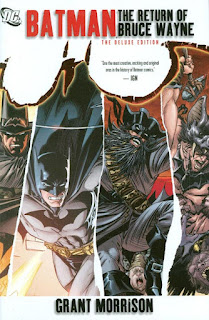
Review: Batman: Return of Bruce Wayne hardcover/paperback (DC Comics)

If you didn't like Final Crisis, then Batman: The Return of Bruce Wayne might not be for you either.

What we have here is some of the best aspects (or the most irritating, depending on your point of view) of Grant Morrison's latest mainstream DC Comics work. Return of Bruce Wayne is a story both modular and overlapping, like Seven Soldiers of Victory, and important events don't so much happen as take place quietly in the background. And, like Final Crisis. Return starts out straightforward and mundane, and ends in the extreme and the fantastical, fully comprehensible possibly only to Morrison himself.

[Contains spoilers]

About three issues in to Return of Bruce Wayne, I was ready to dismiss this miniseries as an unnecessary experiment in Elseworld-ing -- what if Batman were a caveman, what if Batman was a witch-hunter, what if Batman were a pirate. But by this book's final pages, with panels that fracture and crack much like they did in Final Crisis's end of time, it's clear that Return of Bruce Wayne fits firmly into the Grant Morrison canon. This book offers shout-outs at least to 52, Final Crisis, and Batman RIP -- if you haven't been following along so far, I'm not sure Return of Bruce Wayne is the place to start.

One of my other concerns going in to Return of Bruce Wayne is that this book would serve as another step in Morrison's over-the-top deification of Bruce Wayne. I accept that Batman can single-handedly defeat the White Martians and that he's so prepared for any threat that he creates himself a backup personality in case his first was corrupted; I wasn't sure I needed to see Batman fight his way through time so everyone could praise him for that, too. Thankfully, even as there's some of that here (as when Batman builds for Booster Gold and friends the most intricate time machine ever created), Morrison tempers this with one small, startling revelation from Bruce Wayne -- from the moment Alfred tended to his first crime-fighting wounds, Batman has never been a solitary endeavor; Batman has never fought totally alone.

This admission, that Batman gets by with a little help from his friends, does wonders to humanize what's otherwise a wildly fantastical story. Yes, Batman managed to make his way through time and figure out the mystery behind it all in the process, but in each era he had help -- from the Caveman Robin known as "Boy" to Annie, pagan acolyte of the New Gods, and later from Jonah Hex and from the Justice League themselves. Batman states outright that he returns from the lonely end of time to the present, accompanied by a minion of Darkseid that's been stalking him, specifically so that the "Hyper-Adapter" will have to face the age of collected heroes; Return of Bruce Wayne (and the Batman, Inc. team book that follows it) is a renunciation of the idea of Batman as the grim loner, and an embracing of Batman as the team player that Morrison posits he's always been.

As Booster Gold and his team travel back to the present in the ultimate time machine, Rip Hunter remarks on how the end of time loops back through time's beginning, like a knot. Indeed, the reader ought prepare themselves for some mental knots as well. In Return, we learn that Darkseid charged Batman's cowl with Omega energy and sent him back in time, such that the "Hyper-Adapter" can latch on and follow Bruce back to the future, destroying everything. Bruce leaves the cowl behind, essentially evading the trap, except that the meddling Red Robin and the Justice League find it and bring it in to play; Bruce then has to defeat the Hyper-Adapter, turning it in to the giant bat that helps jolt Bruce's memory in the first issue. That is, Darkseid sets a trap at the end of Final Crisis, and Batman uses that trap at the end of Return as the springboard to his own success at the beginning of that same book. The end here is the beginning is the end -- as I said, if you didn't like it in Final Crisis, you might not like it here, either.

Morrison's logic is not completely circular, however; Return is remarkably modular, much like Seven Soldiers was (the similarities don't end in the sameness of Frazier Irving's Klarion the Witch Boy and Return stories both by Morrison). Return can be read on its own, or part of a larger whole that includes Batman and Robin volumes two and three, and Batman: Time and the Batman; it can also be read to some extent both forward and backward (trust me, I tried it). As with Final Crisis, I interpret Return as another Morrison tribute to comics and storytelling, especially in the writer tackling the cowboy and pirate adventure genres; "Whatever they touch turns to myth," Batman narrates at one point, and he could just as easily be talking about the New Gods as Morrison could be about other writers, comics and continuity, as Return is built itself on Peter Milligan's Dark Knight, Dark City. Batman reminds himself of his own existence time and again in this story through the watchword "Gotcha"; it defines not only Batman but also the essence of serial storytelling, the cliffhanger, just as Morrison etched on Superman's tombstone "To be continued" in Final Crisis.

I liked Batman: The Return of Bruce Wayne -- more than I did at the beginning once I began looking farther past the surface, and even more than that when I read it the second time backward -- but Grant Morrison still doesn't quite have me convinced about this Bruce Wayne guy. Before Batman RIP, I didn't like the idea of an "imposter Batman," but Dick Grayson has grown into the role in such a short time, that I'm not enthusiastic about the return of the angsty, uber-capable Bruce Wayne. Return, as it turns out, is not so much about the re-emergence of the Batman Bruce Wayne as it is about Bruce Wayne's trip back. That's engaging, to be sure, but I'm curious to read about Batman's actual return on one of the other half-dozen modules of this story, to see how Morrison re-establishes Bruce Wayne after his being gone so long.

[Deluxe size; printed on glossy paper. Contains full and variant covers, sketchbook section.]

Thursday, March 3, 2011

Uncollected Editions #5: Batman: Bane of the Demon

[Welcome to this month's installment of our "Uncollected Editions" series by Paul Hicks]

I’m concluding my look at the early adventures of the Bat-villain Bane, who will soon set the screen on fire when he appears in The Dark Knight Rises under the thespian guidance of Tom Hardy.

Batman: Bane of the Demon is a four-issue mini-series from 1998. It serves as a character bridge that prepares Bane for his major supporting role in the Ra’s al Ghul focused Batman: Legacy. The mini is again handled by the Vengeance of Bane creative team of writer Chuck Dixon and Graham Nolan and Eduardo Barreto.

Fresh from kicking his reliance on the Venom drug, Bane pops back to his Caribbean childhood hellhole prison of Santa Prisca to have a chat with an elderly monk. As covered in my previous post, Bane’s father was a revolutionary who failed to overthrow the reigning regime, and in his absence, his punishment was inherited by the unborn son. Bane knew his mother until she died when he was six, but he’s never known much about his father other than he was a foreigner. The monk is able to list four possible men who were in Santa Prisca at the time of his conception and Bane is determined to discover this missing piece of his own identity.

Bane thanks the old monk for this information by throwing him out of a high monastery window. This becomes an unhealthy pattern of behavior for Bane in this mini-series: find a source of knowledge, interrogate source of knowledge, eliminate source of knowledge, repeat. It happens so many times in the four issues that it’s almost comical. I’d recommend running for your life if Bane ever asks you the time, or if the special is any good today.

Bane goes on quite a tear investigating option one, if his dad is a mysterious Swiss gentleman who belongs to a mysterious order which is pretty un-mysterious to anyone who’s ever read an Azrael comic. His investigation is sidetracked when his latest target within the Order of St Dumas is attacked by a second group of killers led by Talia al Ghul.

[Interesting how this “following parental leads” plot echoes the plight of Jason Todd in A Death in the Family -- ed.]

This portrayal of Talia paints her as one very sick puppy. She takes an interest in Bane and takes him back to meet her father. The assassins under her command all commit suicide at her request, simply to make the return journey to her father’s base less crowded! When Bane reciprocates her initial attraction to him, they have a quick dalliance and then she decides it’s frosty time. I’m not sure if he was a dud in the sack or if she simply likes her men tall, dark and unattainable. Bane should have taken a leaf from Bruce’s book with Talia -- treat her mean, keep her keen.

Ra’s is interested in having Bane around as at least a new henchman or at best a suitable son-in-law. He and Talia have several increasingly silly conversations in obscure languages in clear earshot of Bane where they discuss their plans to manipulate him and to find the Wheel of Plagues (as seen in Batman: Contagion) which will launch their latest depopulation plans.

This series lacks the gravitas of the Vengeance of Bane specials and does not stand up well without the context of the Batman: Legacy story it leads into. While I was entertained by the ruthlessness of Bane in the series, he ultimately forgets about the search for his father to become involved in Ra’s latest hare-brained scheme.

There is a post-Legacy footnote story that appeared in a prestige format one-shot titled Batman: Bane. This was released to cash in on the character’s minor appearance in the uh, ahem, critically acclaimed and universally, um, beloved Batman and Robin movie (one of four matching one-shots that included Poison Ivy, Batgirl and Mr Freeze). This book shows Bane on a literally suicidal collision course with Gotham City as he commandeers a floating nuclear powered drilling platform. The story by Dixon is entertaining enough, but by this point a lot of the shine is coming off this villain. He no longer seems to be a major threat when Batman has defeated him so readily. But, like every good Bat-villain, Bane escapes to trouble Batman some more in the future. The last page shows him being washed out to sea on debris and remembering that he was doing something before he bumped into those crazy al Ghul’s – “Father!!!” he screams into the elements.

After a pivotal role in Batman: No Man’s Land, there are further significant Bane stories in Batman: Gotham Knights #33-36 and #47-49, but by then Chuck Dixon was off the Bat-wagon and his sometime co-writer Scott Beatty took the reins. Bane’s paternal mysteries are solved at that point, connecting him to another Chuck Dixon creation. I’ll leave you to hunt those down for yourselves if you’re still salivating for the taste of Bane.

[News to me! Now I will have to hunt these down -- ed.]

Bane is currently a member of the Secret Six and his character is in safe hands with Gail Simone. Under her pen, the character has been as well-written as he has been since Chuck Dixon’s early days. Gail has entertainingly played up his social awkwardness based on his highly unusual upbringing.

Thanks for listening everyone. I have many more books I’d like to feature, but I’m always happy to hear your suggestions for future Uncollected Editions.

Monday, February 28, 2011

Review: Gotham City Sirens: Union hardcover/trade paperback (DC Comics)

I thought the Gotham City Sirens series looked silly when DC Comics announced it. They'd canceled the long-running Catwoman series, which in its heyday was an astoundingly good crime noir series that transformed Selina Kyle from dismissible sex symbol to complex anti-hero. Consider that the Catwoman series prior to the Ed Brubaker incarnation sent Selina to women's prison so as to present a gratuitous shower fight, with steam dutifully covering everyone's naughty parts; Brubaker's stories, instead, dealt with alcoholism, guilt, and a grittier Gotham City than we'd seen before even in the Batman titles.

I'd long since stopped reading the previous Catwoman series before the women's prison storyline came around, but I knew that spelled the death knell of that book. There's something that seems to me rather tone-deaf about these kinds of "bad girl" books, a category in which I initially lumped Gotham City Sirens.

Despite the stereotype that comic book fans are male loners at home with their comic books while their peers are out on dates, we know that comic books fans are instead regular people, often adults, of both genders with social lives and a variety of interests. That is, art can be titillating, and so can comics, but when faced with something so ham-handed as Catwoman fighting naked women in the shower, or Hawkgirl wearing lingerie underneath her costume in The Maw, I wonder if the creators believe their audience to be that comic book fan stereotype. At times comics companies seem to think that books can survive on sexual innuendos that might titillate only the most basic of their readership, and I'm skeptical whether that strategy ever actually works.

But whereas indeed Gotham City Sirens has a naked Poison Ivy, a half-naked Zatanna, and for some reason Catwoman no longer ever seems to zip up her costume above her breasts, it also has one other aspect to sell it as more than just a "bad girl" book: writer Paul Dini.

[Contains spoilers]

We know from his years of work on animated Batman series that Paul Dini loves these characters. If Dini's depiction of Catwoman, Poison Ivy, and Harley Quinn, the so-called Sirens, is prurient, then it's prurient with the best of intentions, and he loves them for their minds as well as their bodies.

What I quickly found in Union is that this book is not Chuck Dixon or Gail Simone's Birds of Prey, nor is it Ed Brubaker's Catwoman. The twists in the story aren't terribly complex, nor is there much really gripping drama nor noir moodiness; in fact, the book has an overall air of comedic zaniness to it. I'd describe Sirens as a funny book about Batman's villains, perhaps unfortunately named since the characters in question include the Riddler and the Joker in addition to the three women. When one considers that Arkham Reborn is also a book about Batman's villains, positing this book as a comedy seems an unlikely fit; in essence, however, I'd say Sirens is about as close to the madcap tone Paul Dini achieved in some of his best Batman: The Animated Series episodes as we've seen so far in the DC Universe.

Union takes a while to get started. The purposefully-ridiculous villain that brings the Sirens together is perhaps a bit too silly. Guillem March's art, which is beautiful toward the end of the book, is too distorted here, and makes the whole first chapter feel hastily done. Then immediately Ivy and Harley turn on Catwoman to try to learn Batman's identity; then immediately after that, Hush captures Harley, and Catwoman and Ivy have to save her. It's all very obviously in the service of bringing the characters together, and in that way seems forced and predictable. Even the Sirens' initial fight with the Joker fails to distinguish itself from what we've seen before.

And then Paul Dini reveals the Joker in question as Gaggy Gagsworth.

It's not so much that I give Paul Dini credit for remembering and re-using a sidekick of the Joker who only appeared once at least fifty years ago, as much as how compelling Dini makes Gagsworth in this book's sixth chapter. The Joker is not the antithesis of Batman necessarily, but Gaggy turns out to be an altered version of Robin Dick Grayson, a circus performer who might've had a good life if the Flying Graysons hadn't replaced him in the circus, and then if the Joker hadn't later outgrown him. The irony is thick here in that Gaggy disguises himself as the Joker just as Dick has now taken on the cowl of Batman; even more moving is the way in which the Joker seems to have "put away childish things" by disowning his sidekick (after the death of Jason Todd, maybe?), while Batman's now working with Robin number four.

The book's concluding chapter is a single-issue story where the Sirens spend the holidays apart, and Dini steals the show with his depiction of the family we never knew Harley Quinn had. In a New York-style tenement building, Harley's mother takes care of Harley's lazy, no-good brother and his two kids. Like Oprah, perhaps, one never imagined Harley even had a mother, and then even more amazing is just how normal Harley and her mother's relationship is. Next, Harley visits her father, a con artist in prison, and Dini and March tell more about Harley in one panel than in years of comics -- a panel in whicih Harley's father displays a smile that's not exactly, but very much like, the ever-present smile of the Joker.

Gotham City Sirens: Union works, ultimately, when it's not trying to do too much -- throw the Sirens together, give them a whole bunch of villains to beat, pit them against one another. Rather, the single issue profiles -- of Gaggy, of Harley, writer Scott Lobdell on Riddler -- make this book, giving us unexpected insights into Batman's foes. I wouldn't necessarily put Gotham City Sirens at the top of my "to read" list, but the thought that Dini puts into these stories, especially at the end, satisfied my misgivings about what this book could have been.

[Contains full and variant covers. Printed on glossy paper.]

Timeline updates and more coming this week -- stay tuned!

Twitter Delicious Facebook Digg Stumbleupon Favorites More